
Morale.
What organisations are willing to know.

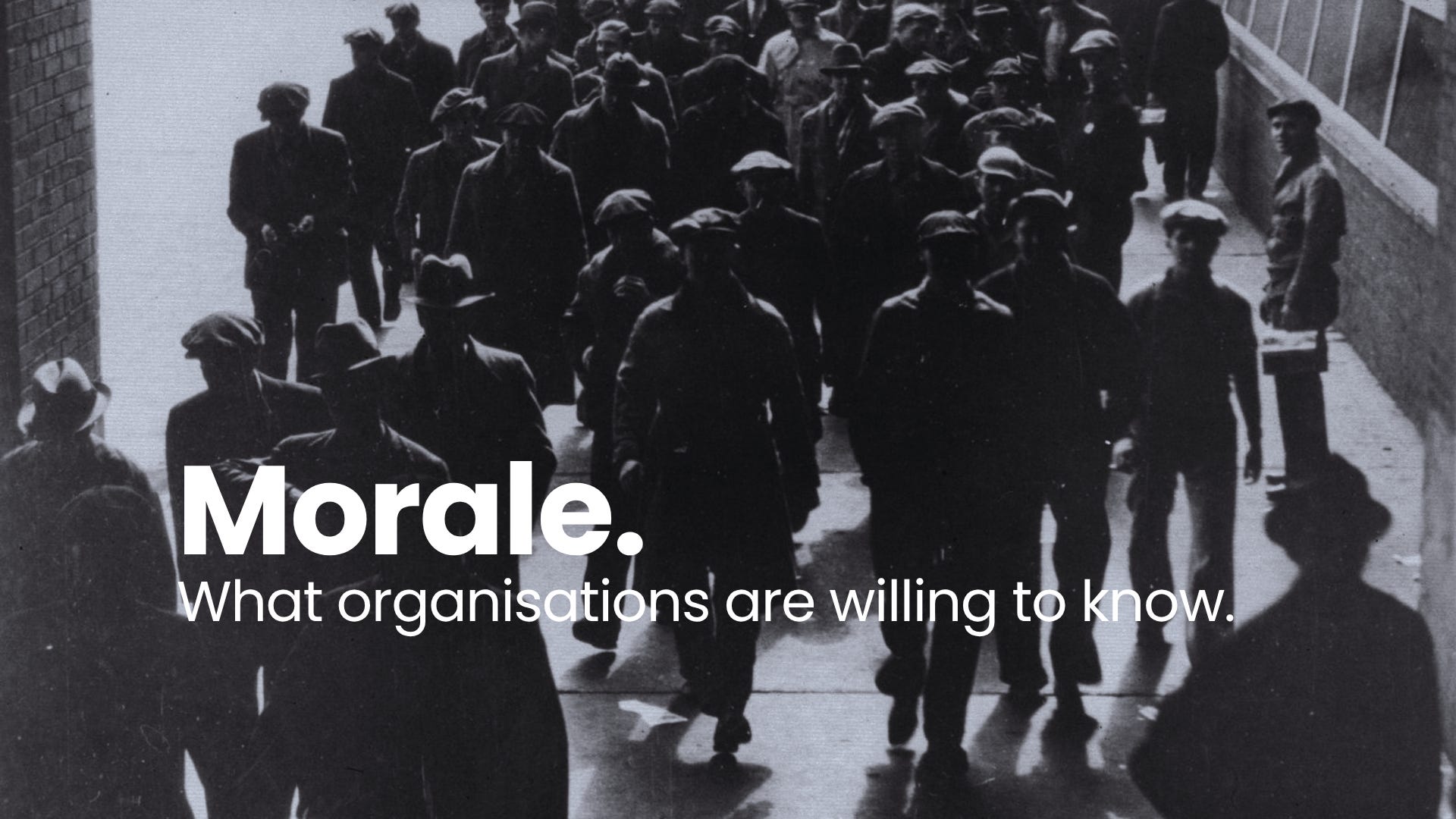
In the spring and early summer of 1917, large parts of the French Army suddenly stopped obeying orders as armies are supposed to. It was not mutiny in the theatrical sense. The men did not turn their rifles on their officers or march on Paris. They did something more limited, and in its own way more revealing. They simply refused to attack.
Their refusal came after the failure of the Nivelle Offensive, launched in April 1917 with promises of a decisive breakthrough, but which instead led to immense losses. The offensive had been sold as the action that would break the deadlock and shorten the war. It did not. By the time it became clear that the promised victory was not coming, French casualties had already climbed to well over a hundred thousand, and unit after unit was being asked to go forward again into the same conditions that seemed to many of the men both futile and intolerable.
The soldiers were not rejecting the war outright. They remained willing to hold the line, to defend their positions, and to fight if attacked. What they would not do was participate in another offensive of the same kind. Exhaustion, refused leave, poor conditions, distrust of the high command, the sense that promises had been made carelessly and lives spent carelessly too: all of it had accumulated into a single shared conclusion.
You can no longer ask this of us.
The initial response from military leadership was the familiar one. Court-martials followed. Hundreds of death sentences were passed, though only a fraction were carried out. It did not work. A lack of discipline was not the problem, and punishment could not restore what had been lost.
When Philippe Pétain replaced Robert Nivelle in May 1917, he went to the front and spoke directly with units. He did not treat the refusals only as insubordination to be suppressed, but as evidence that something had gone wrong in the relationship between what the army needed and what its soldiers could still give. He stopped large-scale offensives, improved leave, food and rest, and addressed the grievances that had made ongoing obedience feel unbearable.
Order returned, not because discipline alone had been reimposed, but because Pétain had attended to the actual conditions shaping his soldiers’ judgement, and changed enough of them.
What he was trying to read was the overall state of the group. Not individual attitudes, not specific grievances, but the condition that determined what could still be asked. The military had a word for it. Morale. It pointed at something real: that the capacity of a group to act was shaped by a condition that existed beneath the surface of formal compliance, and that this condition could shift, sometimes suddenly, in ways that mattered enormously for what could follow.
The same question extended beyond the battlefield. Between 1914 and 1918, with national survival depending on what could be asked of people on the home front as much as at the front line, morale became the word governments, factory managers and civic leaders reached for when they needed to understand what their people could still give. It did not need much definition. Everyone was living inside what it described.
In 1920, the Harvard economist Sumner Slichter published a paper in the Quarterly Journal of Economics titled simply “Industrial Morale”. He was not writing about armies or crisis. He was writing about ordinary working life, and making a claim that now feels both obvious and strangely absent: that the willingness of workers to do their best was one of the most significant variables in industrial performance, and one that management had yet to take seriously. The word appears in his title without qualification. It required no defence.
Slichter was not a peripheral figure indulging a soft idea. By the 1940s, he had become one of the dominant voices in American labour economics: Lamont Professor at Harvard, president of the American Economic Association, founder of the Harvard Trade Union Program, and one of the most influential interpreters of the relationship between workers and industry in his generation. When he wrote about morale, he was not stepping outside the field. He was defining part of it.
What is striking is not only that he wrote about morale, but how. He did not begin by trying to pin the concept down or reduce it to a set of measurable components. He treated it as something already understood, and turned instead to the conditions that erode it: management philosophies that reduce workers to costs, the deliberate use of fear, the weakening of any sense that the work itself matters, the failure to recognise merit, the instability of employment, the fraying relationship between workers and the institutions they serve.
Read now, it is difficult to miss the familiarity. The language belongs to another era, but the pattern does not. What Slichter was describing was not a temporary problem of early industrialisation, but a set of pressures that return whenever the terms of the exchange begin to shift, when effort is still required, but the reasons for giving it no longer hold.
Morale belonged to that part of working life where experience stops being purely private. It was felt by individuals, in tiredness, resentment, commitment, pride, hesitation, but it became visible in the moment those feelings stopped being merely personal and started to resolve into a common sense of the situation. Not necessarily stated, not always conscious, but there all the same: in whether people still believed, still trusted, still gave more than they had to.
Part of what followed was driven by what was happening to organisations themselves. By the early twentieth century, companies were operating at a scale that made older forms of attention harder to sustain. When a factory employed thousands of people across multiple shifts and sites, the kind of proximate reading commanders had practised — being present, speaking directly, sensing what a group could bear — was no longer straightforwardly available. Management was becoming a distinct professional function, separate from both ownership and labour. The question of how people were could no longer be answered simply by being among them. It had to travel upward, across distance, through layers, and in that movement it had to take a form that could survive the journey.
Frederick Winslow Taylor had spent the previous two decades trying to make management scientific. His Principles of Scientific Management, published in 1911, proposed that work could be analysed, standardised and optimised; that the right method, applied to the right task, would produce the right output. The worker, in Taylor’s framework, was a unit of production to be made more efficient. What the worker felt about any of it did not enter the system.
But the feelings of workers did not go away simply because management had no place for them.
Between 1924 and 1932, researchers at Western Electric’s Hawthorne plant outside Chicago conducted a series of studies that began as straightforward efficiency experiments, measuring the effect of lighting, rest breaks and working hours on productivity.
When they improved the lighting, productivity went up. When they reduced it, productivity went up. When they changed the length of rest breaks, productivity went up. When they removed them, productivity went up. When they restored the original conditions, productivity went up.
Almost every intervention seemed to produce the same result, including changes that should, by any reasonable expectation, have made things worse.
The explanation that took hold was simple enough to travel: the changes themselves seemed to matter less than the attention that came with them. Workers were not only responding to altered conditions. They were responding to the fact that someone was paying attention, that what they experienced might matter. That changed the situation.
The studies were messy, suggestive, and later much disputed. Even so, they forced something into view that management could not entirely set aside. Performance depended on more than method. Something about the human situation of the work kept appearing in the result.
Mayo and his colleagues began conducting thousands of interviews with workers, asking about their experience of the work, their relationships with supervisors, what made the job harder or easier to bear. Workers had a great deal to say, and much of what they said pointed not only to the task itself, but to the conditions surrounding it.
But this was a difficult kind of knowledge. The interviews produced insight that was rich but not easily comparable: too varied to aggregate cleanly, too individual to track over time, too discursive to move with confidence through the growing machinery of management, or to compel a response from it.
The problem was no longer seeing it. It was what to do with it once it had been seen.
Then, in 1932, a young psychologist named Rensis Likert proposed a way forward.
His doctoral dissertation, A Technique for the Measurement of Attitudes, offered something the emerging field needed: a way of turning how people felt into something that could be compared, aggregated and tracked. The agree-disagree scale is now so familiar as to be almost invisible. But what it represented at the time was more than a methodological convenience. Feeling could now be translated into number. Once translated, it could move.
The cost was not immediately obvious. To measure an attitude, you first have to define it. The instrument does not simply discover what matters. It measures what has already been brought into view. And in that movement, from condition to attitude, from judgement to response, from experience to scale, something began to slip.
In Britain, just before the outbreak of the Second World War, another path briefly remained visible. In 1937, Tom Harrisson, Charles Madge and Humphrey Jennings founded Mass Observation, a project designed to capture the everyday lives and thoughts of ordinary people not through predefined questions, but through observation, diaries, letters and the careful recording of what people said and did when they were not being asked directly.
When war came again, that work was drawn into service. The government wanted to know how people were holding up: what they feared, what they believed, what they were prepared to endure. Mass Observation offered a way of seeing that.
Its observers described themselves as meteorological stations, gathering fragments of experience from across the country: conversations overheard in pubs and queues, diary entries written at the end of long days, reports from towns and cities under strain. From those fragments, a picture could be assembled. The aim was not a score, but something closer to a weather map: where confidence was holding, where it was beginning to thin, where it might turn.
It was far from perfect. Its methods were uneven, its observers partial, its interpretations sometimes shaped by the assumptions of those doing the observing. But it tried to stay close to experience as it was being lived: shifting, uneven, difficult to summarise, but no less consequential for that.
For a while, both possibilities remained in view. Feeling could be translated into a form that would travel, or it could be followed more closely as lived reality: social, atmospheric, resistant to simplification.
The first proved easier to build institutions around. Not because it captured the whole of the thing, but because it turned it into something that could be compared, moved upward, and acted on with greater confidence. What followed was not simply better measurement. It was a narrowing of what counted as usable knowledge. The condition of a group became the attitudes of individuals. What could not be quantified became harder to defend as real.
Then, in 1973, the Index of Psychological Abstracts removed morale as a distinct category and redirected readers to job satisfaction. A small act of administrative tidiness, but also a sign of where things had arrived. What had once named the condition of a group was now being reorganised as the attitudes of individuals.
What followed — satisfaction, engagement, wellbeing, experience, and others besides — can look, from inside organisational life, like a succession of fads: new vocabularies, new surveys, new dashboards, new promises. But it was something more serious than that. Each emerged because something real had been missed. Each brought one neglected part of working life into view. Yet none answered the question fully, because each had to survive inside a system organised around other priorities: performance, growth, cost, execution, risk. The people question did not disappear. It kept returning in altered form, translated into concepts that could travel upward, survive abstraction, and justify action in terms organisations were already prepared to take seriously.
That was not simply a methodological shift. It also reflected a useful scepticism. To treat how people felt as consequential would have been to accept a different kind of limit on what could be asked, how quickly, and at what cost. It would have made the human effects of managerial decisions harder to dismiss as incidental, and harder to separate from performance itself. Better, then, to keep the evidence contested, the concepts soft, and the subject slightly suspect. In that form it could be acknowledged without becoming binding.
The concepts that survived were the ones that learned to speak the language of performance. They framed attention to people as productivity. They implied obligation, but carefully.
Job satisfaction was one of the first scalable attempts. Not a theory of human flourishing, but a practical instrument for detecting friction: a way of knowing whether the employment bargain was beginning to strain before that strain became visible in absence, turnover or unrest. It captured something real. What it could not capture was the gap between contentment and contribution. People could be broadly satisfied and still hold something back, still do what was required without doing what was possible.
That gap was what engagement came to occupy. William Kahn, writing in 1990, described with unusual care the difference between someone psychologically present and someone going through the motions. What organisations took from the idea was something slightly different: a language for the attention, energy and initiative that performance depends on but cannot command. Engagement succeeded not only because it named something real, but because it named it in terms organisations were comfortable taking seriously. It sounded productive. It promised more of what performance already needed.
What it struggled to show, and what surfaced more clearly through rising concern about stress, exhaustion and burnout, was that an organisation could score well on its instrument while quietly depleting the people inside it. Wellbeing entered the conversation not as a replacement, but as a recognition of that gap. The costs of depletion were real, but delayed, diffuse and often externalised in ways that made them easy to miss. Organisations benefit from engagement immediately. The costs accumulate slowly, and by the time they become visible, they are rarely attributed with confidence to the conditions that produced them.
Experience arrived from another direction. When attitudes alone no longer seemed enough, organisations reached for a design language that made intervention easier. Borrowed from customer experience, it mapped the employee journey, identified the moments that shaped perception, and offered a way of managing what people encountered. This brought a new kind of information into view, but it changed the emphasis again: away from relationships and towards touchpoints, away from shared condition and towards designed interaction.
Different names, different instruments, different claims. The same discomfort underneath.
One of the clearest signs of what kept slipping through appears in an unlikely place. Gallup’s Q12, probably the most widely used engagement instrument in the world, includes among its twelve questions one that has long attracted a particular kind of discomfort.
Do you have a best friend at work?
It sounds soft. Slightly embarrassing, even. It also persists.
Gallup has defended the question for years, linking it to stronger communication, commitment and employee experience. Whether or not it would describe it this way, what the question seems to be reaching for is something older and harder to hold inside an individualised instrument. Samuel Stouffer’s studies of American soldiers during the Second World War found repeatedly that men fought not for abstract causes alone, but for the specific people around them, for the unwillingness to let those particular people down. That is part of what makes the Gallup item so revealing. It points towards the bond that makes someone stay late, cover a gap, absorb difficulty, go slightly beyond what the role requires. Not a personality trait, but something relational, local, held in the space between people.
Parts of that can be measured. The thing itself is harder to hold. Even inside an apparatus built chiefly to measure individuals, something kept insisting on being counted that the apparatus was not quite built to count.
We tried to build a company around that problem.
We called it Happiness Lab.
The name seemed right at the time. The idea was simple enough: that how people felt at work mattered, that organisations would function better if they understood it, and that closer attention to people’s lived experience might tell you something more useful than the surveys most organisations were already running. We were trying to get closer to something real, something lived individually but shaped collectively, even if we did not yet have the right language for it. Happiness seemed like the word for the company. It was not quite the right word for the thing itself.
It took longer than it should have to understand how much trouble that word would cause.
In those early years, we built an extraordinary number of workarounds into our routines: explanations of what we meant by happiness, defences of why it mattered, distinctions between different kinds of happiness, references to research, justifications designed to win permission to address the subject at all. We were spending enormous energy making the question seem credible before we were allowed to ask it.
One senior executive at a large client declared, in a leadership meeting, that he was a conscientious objector to the idea of happiness at work. He said it plainly, without embarrassment. Some people laughed. No one seriously challenged him.
It clarified something I encountered often but had been slow to see. The trouble was not just the word, but the kind of subject it opened onto. Happiness sounded soft, ideological, optional. But the deeper difficulty was that it pointed towards a condition we were trying to infer from individual reports of feeling and experience, knowing that what shaped those reports might be fleeting or long-standing, personal or organisational, and not neatly confined to the boundaries of work. Some of what influenced how people felt belonged to the organisation. Some of it did not. But if it still shaped how they interpreted what was happening around them, how they behaved, and what they were capable of absorbing, sustaining, or offering, then drawing a line around “only the things that relate to work” was less an act of clarity than a narrowing of the field of vision.
We used a daily check-in prompt that asked, “how do you feel today?”, inviting people to answer on a scale from 0 to 100. The question was open enough to let people respond from where they were, rather than forcing them onto someone else’s map of a contested concept. But the number was not treated as self-explanatory. A score of sixty might represent a good day for one person and a bad day for another; what mattered was its meaning in relation to that person’s own sense of good and bad days, and to their pattern over time.
Read only at group level, the signal became something more than mood. We called it the Good Day Ratio. Alongside a stream of anonymous commentary, it allowed condition to be seen as it accumulated, and made visible not only how people were, but how they were beginning to understand what was happening around them.
Only later did the name catch up. Rebranding to Harkn, rooted in hearken, to listen attentively, changed the conversation almost immediately. There is little social cost to being a conscientious objector to happiness at work. It reads as hard-headed, realistic, unsentimental. Listening was harder to dismiss.
In one large business we knew well, something became visible with unusual clarity: how conditions accumulate. What appears from above as a series of separate decisions and events is rarely lived that way by the people inside them. One change alters the meaning of the next. One disappointment becomes the context into which the next demand arrives.
When the second lockdown was announced towards the end of 2020, the initial solidarity was already fading. What it brought was not the shock of the first one but a heavier sense that people who had already given a great deal were being asked for more of the same. Before that had settled, a significant technology implementation began to wobble. One group found themselves working five and six consecutive weekends. Someone used the platform to call out what was happening: the relentless hours, the deadline, the sense that the ask had become unreasonable. The feedback was anonymous, but direct. Leadership saw it, took it seriously, reprioritised the work and moved the deadline. People felt heard. The picture showed a group recovering, briefly but meaningfully.
Then came a pay freeze and the cancellation of bonuses. It was not only the decision itself that did damage. It was how people found out: through informal channels, second-hand, in the way difficult information travels when an organisation has not yet decided how to say it. For people who had already carried so much, this did not feel like disappointment alone. It felt closer to betrayal.
After that came a redundancy process. It was handled better than what had come before; the organisation had learned something. But it arrived as one more weight in a sequence already under way.
Over the course of a few weeks, the ratio shifted from 6.5 good days for every bad one to 1 for 1.
That is the question morale had always been trying to answer. Not just how people feel, but what the organisation is drawing on, what it is asking in relation to what remains, and what might happen if it gets that balance wrong.
And both throughout and beyond it, the work had to be done, so the asks continued. The organisational version of “over the top” is familiar: the renewed appeal for resilience, commitment, one more push. But by this point, trust had been diminished, belief had weakened, and people were carrying the weight of everything that had come before. It was now being asked of people who were no longer what they had been at the start.
At the end of it all, once the sequence had run its course and business had returned to a different sense of normality, it took twenty-two months for the ratio of good days to bad days to return to where it had started.
The pattern was clear enough to matter. What remained difficult — for us, and not only for us — was turning that visibility into the kind of proof organisations usually want. What emerged was a pattern in which one event appeared to alter the meaning of the next, and recovery failed to arrive before the next ask was made. What we could not produce was the cleaner claim the field has always struggled to produce: this decision caused that outcome; this condition cost exactly this much; this is the precise point at which diminished morale becomes diminished performance.
And that difficulty matters. Because in practice, the consequences of lowered morale often become undeniable only at the point of refusal: when people stop volunteering, stop believing, stop returning, stop staying, stop coming back. By then, whatever damage the condition was doing had usually already been done.
And for those who still did not believe that any of it mattered, the evidence changed nothing.
That this remains an acceptable position tells its own story. Once knowledge has been shaped into forms organisations can receive without discomfort, the knowledge that still produces discomfort begins to feel excessive, soft, optional, not quite business-critical.
Modern organisations are not armies, and work is not war. But they do share an underlying reality. They rely on forms of human willingness they cannot command outright, and they make demands that depend, at times, on belief, trust, judgement and endurance. The problem is not that organisations know nothing about these things. It is that they still do not treat knowledge of them as carrying enough authority to interrupt what they have already decided to ask, and that is where the field remains incomplete.
Over the past century, we have produced better instruments, cleaner categories, richer descriptions and more continuous forms of attention. What has not yet been settled is the harder question underneath them all: when the condition of people becomes visible, what claim does that visibility have on the organisation? Is it interesting? Actionable? Regrettable? Or binding?
The French Army did not begin listening because it had discovered a more enlightened philosophy of leadership. It listened because it had run out of room to ignore what the condition of its soldiers had already made true. That is the threshold most organisations still try not to cross. They prefer to know early, but lightly; to monitor, but without being stopped; to listen, but without surrendering the right to continue unchanged.
And so the problem is no longer simply a matter of measurement. It is not even, at root, listening. It is whether what becomes known about people is allowed to place any real limit on what the system feels entitled to demand.
That is what has been missing from a century of trying to understand how people are at work.
Not more data.
Not better dashboards.
The willingness to let what becomes known about people limit what can be demanded of them.
You eloquently express why I became disillusioned with and cynical about organizations years before I finally left. Rather: got kicked out and then decided never to return to corporate. And never to help them extract more from their flesh-and-blood machinery.
Human capital? Human resources? Don't make me laugh. Organizations only invest in those areas to reduce all costs to greater shareholder value. Not because they genuinely recognize the value of helping their people (not resources, not capital) to thrive, and genuinely recognize that helping people thrive at home frees them neurologically, biologically, and socially (at work) to benefit the company as best they can.
The irony is that people ALWAYS do their best every single day of their lives - given their history throughout life (including work), their environment (!), their temperament, their knowledge and skills - and companies just don't 'get' or are willing to acknowledge that their bottom line is impacted entirely by how well they help their people thrive.
I've vowed I'll only work with or for companies small enough to know everybody in it intimately. Preferably solopreneurs and (very) small teams. WITHOUT the aim of an early exit or growing into a medium, let along big organization.
Because the other uncomfortable truth your article points to is that business (that needs management layers) is very good at de-humanizing people into resources and assets they can move around like pieces on a chessboard and drive like inanimate machines.
Small is human. Small is beautiful. Just ask Eckart Wintzen (you'll have to be satisfied with his writing, I belief he's no longer among us).