
Primacy (revised)
The story that rewrote the rules of work.

In Chapter 5 of Supremacy, a bestselling book about AI and the future of business, Parmy Olson writes: “Google had a fiduciary duty to its shareholders to grow its profits every year.” She doesn’t dwell on it. It’s not the point of the chapter. Just a passing sentence that she drops and moves on. Like it’s not up for debate.
But it should be. Because it isn’t wholly true.
Legally, fiduciary duty runs to the company itself, not its shareholders. But in practice, the two have become almost indistinguishable. And that belief explains a lot. It explains why leaders make decisions that seem ruthless, even in good times. Why layoffs are seen as discipline, not failure. Why caring for people feels, weirdly, like a luxury. And once you believe it, even vaguely, even unconsciously, it lets the whole system off the hook. After all, what can you do? The company had no choice. That’s just how business works.
Except — is it?
Because if it’s not wholly true, then we’re not talking about a rule. We’re talking about a story. One that reshaped everything, including the meaning of work itself.
The contest
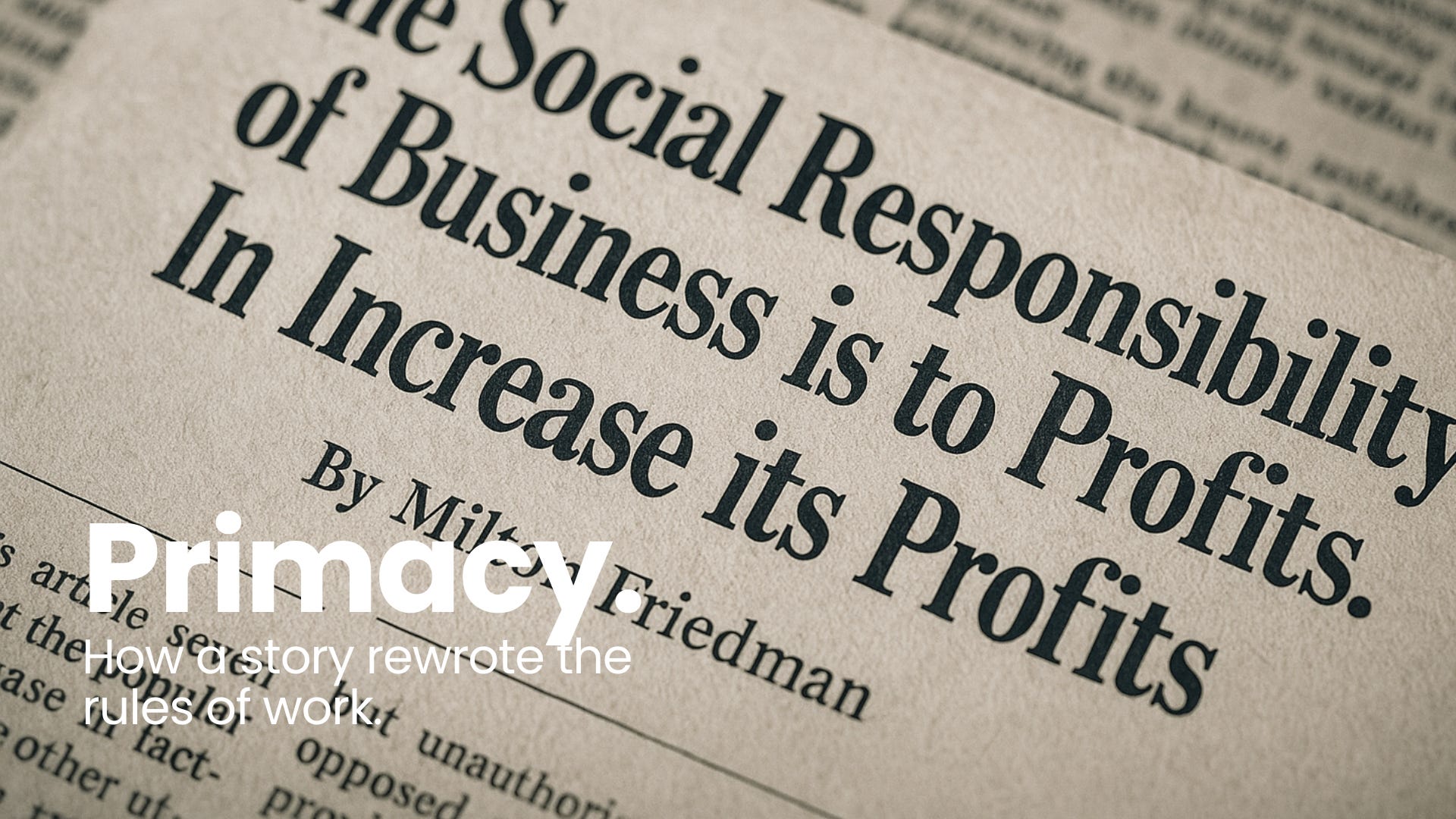
Most people, if asked where that story came from, would point to Milton Friedman. In September 1970, the Nobel laureate economist published an essay in the New York Times Magazine arguing that the only social responsibility of business was to increase its profits. It became, in the telling, the moment everything changed — the essay that gave shareholder primacy its moral authority and sent it out into the world.
But the story is older than Friedman, and less settled than it appears.
In 1916, Henry Ford announced he was stopping the special dividends at Ford Motor Company. The surplus had reached $60 million. The Model T had made motoring accessible to ordinary people, and Ford had cultivated a reputation as something more than an industrialist — the man who paid his workers five dollars a day when the going rate was half that, who said he believed the people building his cars should be able to afford to buy them. Like many stories associated with Ford, the reality was more complicated. The $5 day was real. The motivation was less clear — turnover on the brutal assembly line was costing him more than the wage increase.
In that spirit, or at least in that language, Ford announced the money would go toward expanding production, lowering car prices further, and employing more people. In his own words: “My ambition is to employ still more men, to spread the benefits of this industrial system to the greatest possible number, to help them build up their lives and their homes.”
Two brothers disagreed. John and Horace Dodge owned ten percent of Ford Motor Company and had been using those dividends to fund their own competing car company. They sued. And the Michigan Supreme Court ruled in their favour, ordering Ford to pay the dividend. Its reasoning was unambiguous: “A business corporation is organised and carried on primarily for the profit of the stockholders. The powers of the directors are to be employed for that end.”
Ford’s motives, it turned out, were not purely altruistic either. He also needed cash for the massive River Rouge factory he was building, needed to keep workers loyal to prevent unionisation, and there is evidence he was trying to squeeze out the Dodge brothers as competitors. When the court offered him the opportunity to justify his decision on straightforward business grounds, he declined, insisting instead on the charitable rationale. That stubbornness may have handed the court its ruling. It was a state court in Michigan, not a federal precedent, and its significance as a statement of law is arguable. But the ruling said something that hadn’t been said quite so plainly before — and it would be heard again.
Thirteen years later, in the depths of the Great Depression, two law professors picked up the argument in the pages of the Harvard Law Review. Adolf Berle, Columbia Law professor and key architect of Roosevelt’s New Deal, argued that managers should be legally accountable to shareholders — not because shareholders were morally primary, but because without clear legal accountability to someone, corporate managers would answer to no one. Merrick Dodd, a Harvard Law professor, disagreed. Corporations had both a profit-making function and a social service function — obligations to employees, customers, and communities, not just shareholders.
The argument didn’t resolve in Berle’s favour. It resolved, gradually, in Dodd’s. As the New Deal took hold, as regulation expanded, as corporations increasingly accepted social obligations — through better wages, pension schemes, community investment — the idea that companies existed solely for shareholder return looked less and less like common sense. By 1954, Berle himself conceded the point. “Twenty years ago,” he wrote, “the writer had a controversy with the late Professor Dodd. The argument has been settled squarely in favour of Professor Dodd’s contention.”
The man most associated with the intellectual origins of shareholder primacy had concluded that the other side had won.
And then came 1970. Twenty million Americans participated in the first Earth Day that April — the largest civic demonstration in American history to that point, a direct response to oil spills, rivers catching fire, and air thick enough in some cities to taste. The Environmental Protection Agency was founded that same year. Rachel Carson’s Silent Spring had already shifted public consciousness about what industrial activity was doing to the natural world. Corporate social responsibility was a live and serious movement. The Business Roundtable was moving toward a stakeholder model that explicitly included employees, communities, and the environment alongside shareholders.
It was into this landscape that Friedman published his essay — not as the statement of an emerging consensus, but as a challenge to one. He wasn’t primarily making an economic argument. He was making a political one, dressed in economic language: that the corporation belonged to its shareholders, and that any claim on its resources by workers, communities, or the environment was an encroachment on the freedom that separated capitalism from socialism. The Wall Street Journal called it anachronistic. Most executives dismissed it. The prevailing wisdom held.
For now.
The mechanism
What changed wasn’t minds. It was the conditions. In the late 1970s, American corporations were under pressure. Inflation was high, productivity was sluggish, and the stock prices of many large companies had fallen so far below the value of their underlying assets that they looked, to the right kind of eye, like opportunity.
That eye belonged to the corporate raider — men like T. Boone Pickens, Carl Icahn, and Ron Perelman, who had realised that you could borrow money, buy a controlling stake in an underperforming company, strip out the inefficiencies, and walk away richer. The target company bore the debt. The raider took the return.
They needed a justification. Friedman had written one.
In 1983, Pickens launched a bid to take over Gulf Oil. In the Wall Street Journal, he declared that he was “dedicated to the goal of enhancing shareholder value.” It was one of the earliest recorded uses of the phrase. Gulf Oil was eventually sold to Chevron in what was then the largest corporate acquisition in American history. The phrase Pickens had used began to travel.
What gave it teeth wasn’t just the raiders. In 1976, finance professors Michael Jensen and William Meckling published a paper arguing that the fundamental problem of the modern corporation was the misalignment of managers’ and shareholders’ interests. The solution was to align their financial interests — to pay executives in stock, so that when the share price rose, they rose with it. Through the 1980s and into the 1990s, executive compensation shifted dramatically toward stock options. By the end of the decade, the majority of CEO pay in America’s largest companies was tied to share price. Executives no longer needed to be convinced of shareholder primacy. They had a direct and personal financial interest in it.
The doctrine spread not just through boardrooms but through the business schools that fed them — a generation of managers trained to read balance sheets and manage costs, for whom Friedman’s logic wasn’t a controversial position but simply the norm.
The argument that had been losing in 1954 and had been dismissed as anachronistic in 1970 had found its machinery. And once it was in the machinery, it no longer needed to be argued.
The asymmetry
The other side didn’t disappear. It never has. We still talk about corporate social responsibility. We still debate stakeholder capitalism. We still publish ESG reports and convene summits at which chief executives declare their intention to be a force for good. In 2019, the Business Roundtable issued a statement signed by 181 CEOs explicitly abandoning shareholder primacy in favour of a broader stakeholder model. The argument that Dodd was making in 1932 is still being made. The argument that Ford was making — however impurely — in 1916 is still being made.
But the two sides of this argument do not meet as equals.
The language of stakeholder capitalism is the language of aspiration. The language of shareholder primacy is the language of obligation. Companies can choose to care about their workers, their communities, their environmental impact. They cannot easily ignore their shareholders — not because the law demands it, but because the machinery enforces it. Investors can sell. Activists can intervene. Boards can replace leadership. Markets can reprice the company. None of that is a courtroom. But it is pressure. It is constraint. It is a form of enforcement that operates constantly, without anyone having to invoke it.
When an executive explains a round of layoffs, the justification requires no defence — shareholder value, operational efficiency, returning capital to investors. When the same executive wants to invest in worker development, or protect a community, or absorb a short-term cost for a long-term social benefit, the burden of proof runs the other way. One set of responsibilities is assumed. The other must earn its place.
That asymmetry — between what is structurally enforced and what is merely encouraged — is not the result of anyone’s decision. It happened through accumulation — through the raiders who needed a justification, through the academics who provided the framework, through the executives whose pay made the logic feel like self-evident truth. Each step followed from the last. And somewhere in that accumulation, one side of a genuinely contested argument stopped needing to be argued.
What it does
This is how the belief sustains itself — not because it’s true, but because it works. Because it explains away the hardest choices. Because it makes what feels like ruthlessness look disciplined. And because, over time, that discipline becomes the performance.
In Q1 of 2024, Alphabet posted $23 billion in profit. A record quarter. But that didn’t stop the company from announcing another round of layoffs. The justification was to “remove layers to simplify execution and drive velocity.” It’s the kind of language markets recognise. It tells a clear story: this is a disciplined management team doing what’s necessary to stay efficient. The subtext? We know the rules, and we’re playing by them.
Alphabet isn’t alone. In 2025, more than 62,000 jobs were cut across nearly 300 technology companies in the first five months of the year — Microsoft, Intel, Amazon among them — even as companies reported strong financial results and CEO pay continued to rise. The language barely changes: “sharpening our focus,” “becoming leaner,” “improving operational discipline.” These aren’t distressed companies. These are companies sending signals. Serious management doing what serious management does.
Sometimes the language is even more unguarded than that. When Five9, a cloud software company, announced layoffs to its staff, the internal communication opened with these words: “As we continue to focus on shareholder value... we need to make some changes to our organisation design.”
When companies cut costs through redundancies, it’s not just the people leaving who feel it. Everyone does. You haven’t just reduced headcount — you’ve redrawn the map of belonging. You had one workforce. Now you have two: those who are going, and those who are staying. And that line runs straight through teams, friendships, and years of shared experience. It doesn’t just affect morale — it affects trust. And not just in leadership, but in the relationship itself.
People want to know what this says about them — and what it says about the company. Were they told the truth? Did leaders show up? Were people treated with care, or managed like inventory? Because if the people leaving are treated as liabilities to be managed rather than people to be supported, then everyone watching learns something. They learn that care is conditional. That relationships are transactional. That trust might be a risk.
We saw all of this up close — not in hindsight, but in the moment. Shock. Frustration. Confusion. And yes, sometimes even support and humour. These weren’t just stories — they were signals. And they showed us what these decisions really do to morale, to trust, to the emotional fabric of work.
But life in the organisation continues. Deadlines will still be met. Meetings will still happen. The work will get done. From the outside, the signs are good. The share price holds up. To most observers, the business is working just fine.
But what if it isn’t?
For decades, responsible organisations have operated on a different assumption: that people matter, that their commitment matters, that companies perform better when people feel safe, valued, and involved. But if companies can treat people as expendable — reducing their security, minimising care — and performance doesn’t suffer, then maybe we’ve all been operating on a faulty assumption. If people start treating work as just a transaction, lowering their commitment, reducing their emotional investment, and the company doesn’t suffer, that raises a bigger question.
Does any of it matter?
Because if the answer is no, then the entire premise of engagement, culture, and even leadership starts to look fragile. And the damage won’t stop at one organisation. It becomes ambient. It spreads.
Assumption embedded
There’s a social media account I’ve followed for a while — @shiftingshares — he focuses on practical investment advice. He talks about companies and markets from an investment perspective with authority and genuine clarity.
He recently shared a video offering an apology for comments he’d made about a high street coffee chain, in which he’d accused them of siphoning profits offshore and adding little or no value to the UK. “What I said wasn’t entirely fair,” he said.
But the apology was a feint. He wasn’t retracting his statement — he was widening it. It wasn’t fair to single out one company. And he goes on to add a few more to the list. Large faceless corporates, as he calls them, dominating our high streets and threatening local business.
Then he says, “What they’re doing isn’t illegal. In fact, if they didn’t do it, they could actually be sued by shareholders for not acting in shareholders’ interests.”
And that’s it. Right there. The assumption so deeply embedded that even someone who spends his time thinking seriously about how companies and markets work has mistaken it for fact.
It isn’t quite right. But it doesn’t need to be. The pressure is real, even without a courtroom. The system enforces it through investors who can sell, boards who can replace executives, and markets that can reprice overnight.
That is what a fully embedded assumption looks like.
The return
Which brings us back to Parmy Olson, and the sentence she didn’t need to defend.
She wasn’t wrong to drop it without explanation. She was writing for an audience that would recognise it as common sense — because it has become common sense, absorbed so thoroughly into the way we think about business that it no longer requires justification. But it was necessary once. There was a courtroom in Michigan where a judge had to decide what a company was for. There were two law professors arguing opposite sides of the same question, and the man who appeared to be arguing for shareholder primacy later conceded that the other side had won. There was a moment when environmental responsibility, stakeholder thinking, and corporate social responsibility were all live and serious alternatives — when the question was genuinely open. And there was a hotel suite in 1983 where a Texas oilman reached for an essay because he needed a justification, and found one waiting.
The argument didn’t end. It became unequal. One side found its way into the machinery — into the incentives, the governance structures, the accountability systems that shape every decision made in every boardroom. The other side is still making its case in sustainability reports, stakeholder statements, and ESG frameworks, still trying to find the lever that will give it the same structural weight.
That is the world Olson is writing in. That is the world most of us work in. And it is not the only world that could have emerged from that argument.
What it did to the people inside organisations — to the meaning of work, to the relationship between companies and the people who gave their working lives to them — is where this story goes next.
Once again this arrives at the same time as I’m hearing about references to the same subject the wider world. Friedman has a lot to answer for.
Interestingly, many of the behaviours exhibited by these larger companies are absent in much smaller companies. The alignment and engagement is more tangible, possibly due to a shorter feedback time between action and consequence.
Great write up. Didn't know that a court decided what business is supposed to be for. And explains a lot of the unsustainable practices prevailing in the US and spilling over to the rest of the world. I guess we need a couple of court cases challenging that "jurisprudence" and making social and environmental responsibility part of what a business is for. I've always said it won't take hold until we make it part of the balance sheets and profit and loss statements. Now, I understand we need one more thing for it to become reality: and that's to make it part of the legal stuff around business.